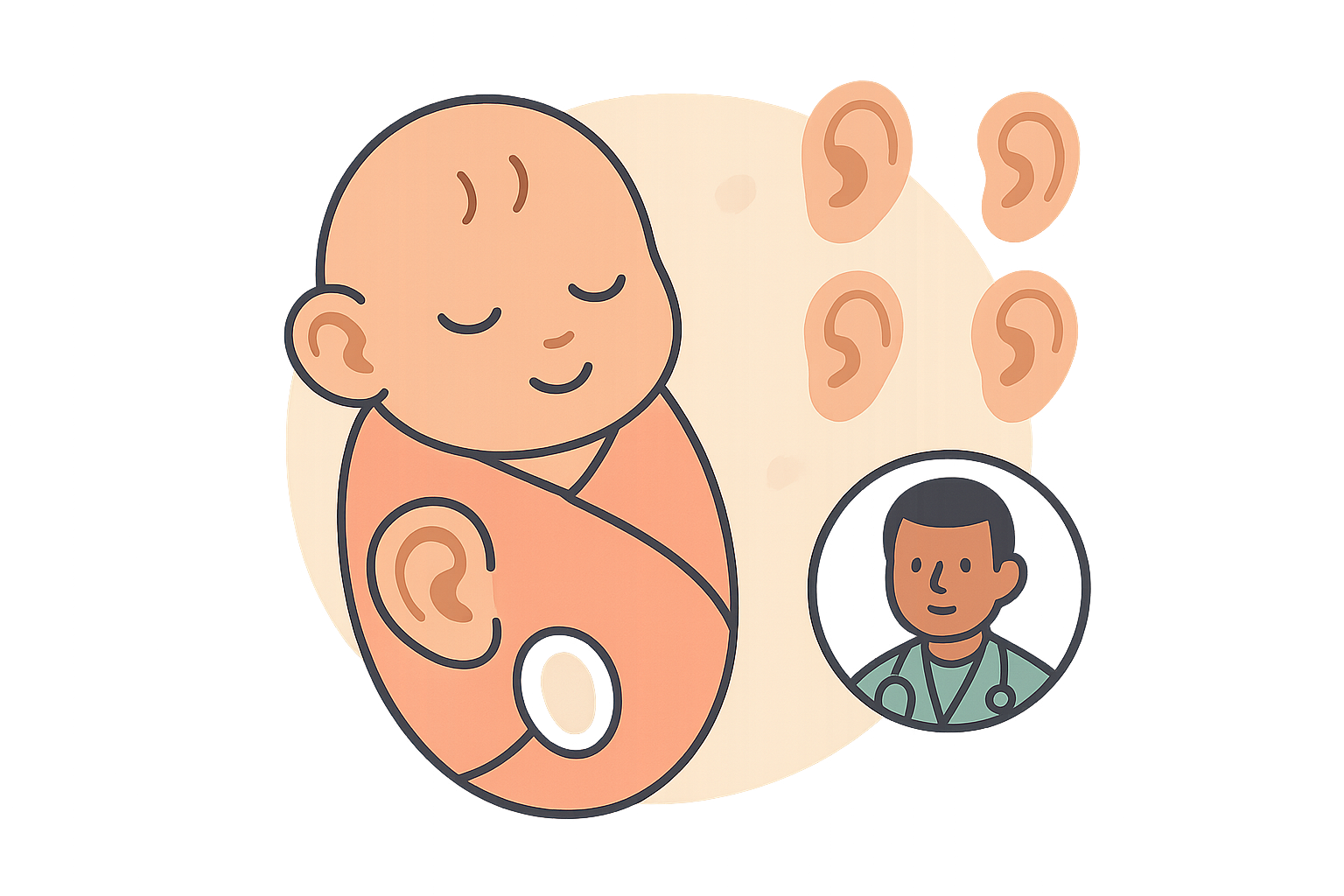

You notice it while feeding or snapping a photo. One ear looks folded, pointy, or a little squished. Cue the 2 a.m. Google spiral.
Take a breath. Many newborns have ear shapes that look unusual in the first days and weeks. Often this is cosmetic and not a hearing problem.
The good news is there is a short window when gentle, non-surgical molding can guide the ear into a more typical shape. It is not a DIY project. It is something a trained clinician does with soft splints and skin-safe tape.
Not every ear needs treatment. Some shapes relax on their own as the cartilage firms up. The trick is knowing when to watch and when to act, because timing matters.
If you do one thing today, snap a few clear photos of both ears from the front and side in good light. Then bring it up at your baby’s next visit or call your pediatrician sooner if you are worried.
TL;DR
Some newborn ear shapes look bent or folded but do not affect hearing. Early ear molding, done by a clinician in the first weeks, can often correct these shapes without surgery. Ask your pediatrician quickly if you are interested, since results are best when started early.
Ear molding for newborns, explained
When molding works best
- Best timing is usually in the first 1 to 2 weeks after birth, and often within the first 6 weeks.
- It can still help a bit later, but results are less predictable as the ear cartilage stiffens.
- Molding works for shape problems where the ear parts are present but bent or folded. It does not correct ears where parts are missing or very underdeveloped.
What actually happens at an appointment
- A pediatric ENT, plastic surgeon, or trained clinician examines both ears and explains options.
- Small, custom supports are shaped to your baby’s ear and secured with gentle adhesive.
- You go home with the mold in place. It stays on around the clock and is checked and adjusted weekly.
- Typical duration is 2 to 6 weeks, depending on the starting shape and how the ear responds.
Results, risks, and limits
- Many families see meaningful improvement, sometimes near full correction for flexible folds.
- Minor skin irritation can happen. Teams watch for this and adjust or pause if needed.
- If molding starts late or the ear is very stiff, changes may be smaller.
- Molding cannot fix missing cartilage or ear canal problems. Those need separate evaluation.
What to look for in a provider
- Experience with newborn ear molding and the specific shape you are seeing.
- Ability to start quickly, ideally within days, not weeks.
- Medical-grade materials and a weekly follow-up plan.
- Clear photos of prior cases or a willingness to walk you through realistic outcomes.
- Transparent discussion of costs and help with insurance paperwork.
- A plan for what to do if the skin gets irritated or a mold loosens.
FAQ
Understanding and timing
Q: Will a misshapen newborn ear affect my baby’s hearing?
A: Most outside ear shape differences do not affect hearing. The newborn hearing screen catches most issues. Call your pediatrician if the ear canal looks very small or closed, if you missed the screen, or if your baby does not startle to loud sounds.
Q: Will the ear shape fix itself?
A: Many mild folds improve in the first few weeks as swelling settles. If the shape is still clearly there by 2 to 3 weeks, ask for a referral for ear molding. Early action gives you the most options.
Treatment and safety
Q: How soon should ear molding start and how long does it take?
A: Sooner is better. It works best in the first 1 to 2 weeks and can still help up to about 6 to 8 weeks. Most cases need 2 to 6 weeks of molding with short check visits.
Q: Is ear molding safe? Can we tape the ear at home?
A: Ear molding is noninvasive and usually well tolerated when done by a trained clinician. Expect gentle devices and skin-safe adhesives plus regular skin checks. Avoid DIY taping. It can cause sores or change the shape in the wrong direction.
If your baby’s ear looks folded, pointy, or a little different, take a breath. Most newborn ear deformities are shape differences, not signs of hearing problems. Many soften on their own as your baby grows.
The early weeks are special. Newborn cartilage is like soft clay for a short time. That is when ear molding can gently guide the ear into a more typical shape.
Not every ear needs treatment. If it is mild and not bothering you or your baby, watching and waiting is reasonable. If it makes glasses or nursing tricky, or it is a shape you hope to change, an early referral helps.
You do not have to figure this out alone. Start with your pediatrician. If molding makes sense, ask for a quick referral to a pediatric ENT or plastic surgeon who does ear molding in infants.
Your next steps, at a glance
- Take clear photos of your baby’s ears from the front, side, and back in good light.
- Bring it up at your next newborn visit or call sooner if you are worried. Ask if your baby is a candidate for ear molding.
- If molding is offered, try to be seen in the first 1 to 6 weeks. Sooner is usually easier and faster.
- Skip DIY taping or gadgets. Skin is delicate and infections are a real risk.
- Keep an eye on feeding, comfort, and hearing screens. Flag anything off to your clinician.
- Ask about cost and coverage before you start. Many plans cover molding when it is started early.
How to decide: wait, mold, or refer
- Watch and wait can fit when the bend is mild, the ear canal is open, and there are no other concerns. Plan a recheck in a few weeks.
- Ear molding fits best in the first weeks of life for shapes like lop ear, Stahl’s ear, cup ear, and conchal crus. It is non-surgical. Most families see meaningful improvement with a few weeks of molding.
- Refer now if the ear canal looks very narrow or absent, if there are facial asymmetries, or if you have any hearing concerns, feeding trouble, or other anomalies. Your pediatrician can route you to a pediatric ENT or craniofacial team.
Edge cases that need a different plan
- If your baby was premature or had extended time in the NICU, molding might still be possible, but timing can shift. Ask your team.
- If the top of the ear seems tucked under the scalp skin (cryptotia) or if the ear is underdeveloped or missing parts, you still may start with molding. Surgical planning, if needed, usually happens later in childhood.
- If there is redness, drainage, or skin breakdown on the ear, pause and call your clinician. Treat the skin first.
How we handle medical info here
Medical review and sources
We write for parents first and keep the language plain. For clinical accuracy, we ask a pediatrician or pediatric ENT to review guides like this before we publish. We rely on peer‑reviewed studies, society guidelines, and statements from groups like the American Academy of Pediatrics and pediatric ENT and plastic surgery societies.
This guide is general information, not medical advice for your child. Your pediatrician knows your baby best.
Photos and illustrations
Photos in this post are licensed or used with permission and are for education only. They show common shapes to help you talk with your clinician. Please do not use images as instructions for DIY molding or taping.
See something we should update?
Medicine evolves and so do insurance rules. If you spot an error or have a question we did not answer, send us a note. If this was helpful, subscribe so you get our next parent-to-parent health guide without hunting for it at 2 a.m.



Leave a Comment