
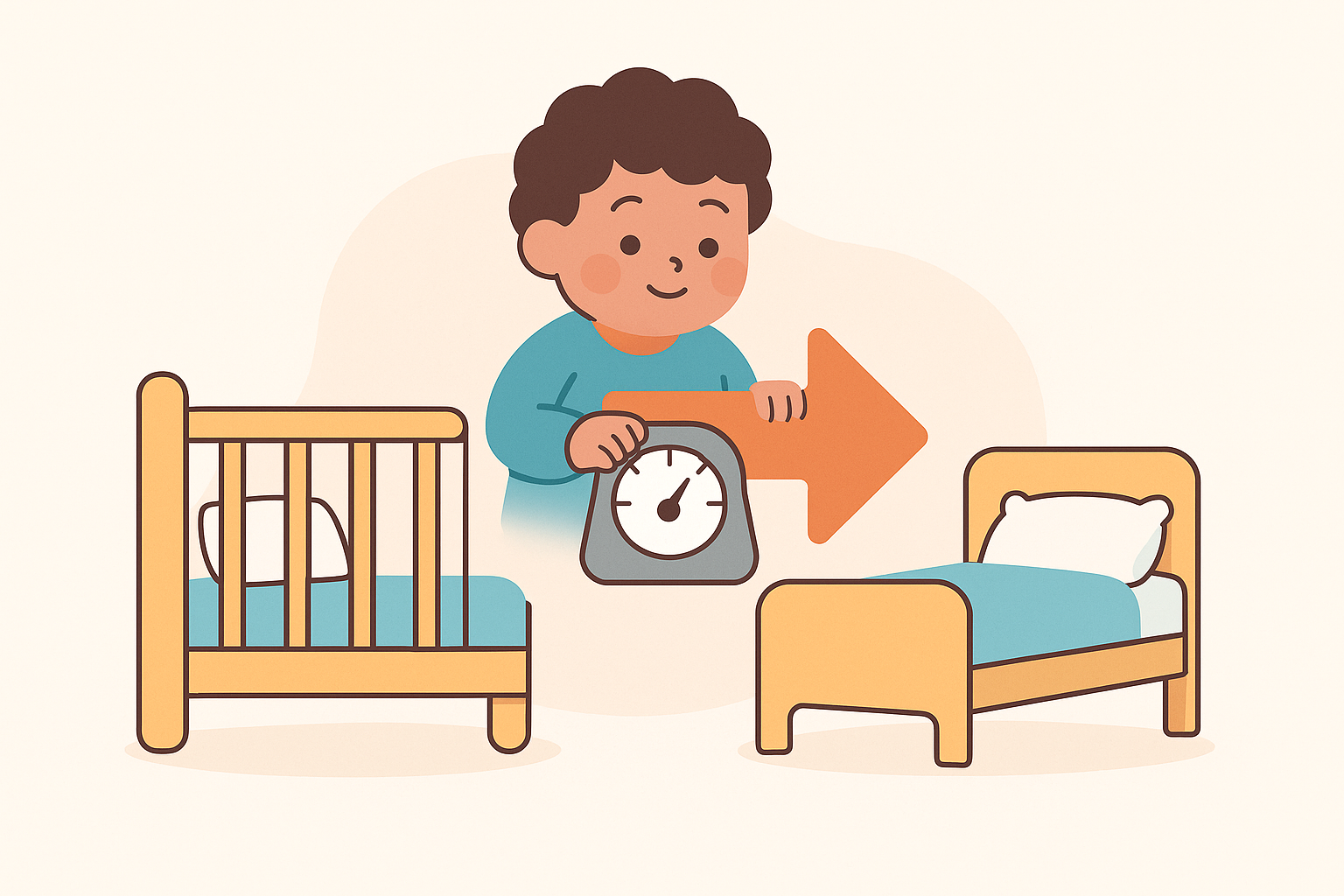

You’re staring at the crib at 2 a.m., Googling crib weight limits and replaying that almost-climb your toddler tried at nap. We’ve been there. It’s a weird mix of pride and panic.
This guide is for the in-between stage. When your baby is not a tiny baby anymore, but you’re not totally sure if a toddler bed is safe yet. You want a clear plan that keeps your kid safe and keeps sleep from falling apart.
Our goal: help you decide when to switch and show you exactly how to do it without chaos. Success looks like fewer escapes, fewer bumps, and a bedtime that still works. You do not need to buy everything. You do need a few smart safety checks and a room that’s ready.
One quick do-this-first step: tonight, drop the crib mattress to the lowest position and remove anything climbable like bumpers, pillows, big toys, or stuffed animals. That alone buys many families time to make a calm plan.
The quick answer: when to switch, safety first
If they can climb out or are around 35 inches tall, start the transition
Most kids move out of a crib between 18 months and 3.5 years. The exact age varies a lot. What matters more are two hard lines:
- If your child has climbed out once or is actively trying, start planning the switch now.
- If your child is about 35 inches tall, many pediatric and safety groups say it’s time. Taller kids can leverage their height over the rail.
Before you switch tonight, try the simplest fix first: lower the mattress, remove climb assists, and use a sleep sack if your child still tolerates it. If your child still attempts to scale the rail, it’s not worth the risk. Move to a safer setup.
Check the manual for crib weight limits and conversion guidance
Cribs are built for babies, but the details vary by model. Here’s what to look for:
- The label. Find a sticker on the crib base, inside the headboard, or under the mattress platform. It lists limits and warnings.
- The manual. Search the brand and model online if you lost it. Look for language on when to stop using the crib and any toddler-bed conversion limits.
- Common pattern. Many cribs do not list a strict weight limit for the infant stage, but most say stop when your child reaches 35 inches or can climb out. If your crib converts to a toddler bed, that stage often has a weight limit, commonly around 50 pounds. Follow your crib’s exact numbers.
Why this matters: manufacturers design and test to specific limits. If the label says stop at a certain height or weight, that’s your line. It’s about preventing falls and using the crib in the way it was tested.
Behavior and room safety count as much as height and weight
Readiness is not just physical. Consider:
- Can your child follow a simple boundary like “books, then bed” and “stay in bed until the light turns on”?
- Does your child wander or stand quietly looking for you? Wanderers need extra room safety before they leave the crib.
- Is the room childproofed like a giant crib? Anchored furniture, no dangling cords, outlets covered, window locks in place, and a door you can secure with a childproof cover or safety gate.
Edge cases to keep in mind:
- Petite climbers under 35 inches often need to switch sooner for safety.
- Tall but cautious kids who don’t try to climb can sometimes stay a bit longer, as long as the mattress is low and the rail is well above chest level. Recheck weekly. The moment they attempt a climb, move on the plan.
How to transition safely: step by step
Step 1: Make tonight safer in five minutes
- Lower the crib mattress to the lowest position.
- Remove bumpers, pillows, quilts, and big stuffed animals that can be used as steps.
- Check and tighten all crib hardware.
- If your child still tries to climb, sleep your child on a crib mattress on the floor in the middle of a childproofed room for the night while you set up the long-term solution. It’s not fancy. It’s safe.
Step 2: Childproof the whole room, not just the bed
Once a child is out of the crib, the entire room becomes their sleep space.
- Anchor dressers and bookcases to studs.
- Move the bed at least a couple of feet from windows. Lock windows and secure blind cords out of reach.
- Use outlet covers and cord management. Tape down lamp cords or remove table lamps.
- Keep small objects, diaper creams, and humidifier parts out of reach.
- Add a soft rug next to the bed to cushion short falls.
- Consider a gate at the bedroom door for overnight wandering.
Step 3: Pick a safe placement for the new sleep surface
Whether you choose a toddler bed, a convertible crib with the front off, or a floor mattress, placement matters.
- Put the sleep surface against a solid wall, but leave a few inches so there’s no entrapment gap. If there is any gap, fill it with a snug rail or move the bed flush.
- Keep the area around the bed clear. No hard corners, no toys that roll, no framed art within reach.
- Avoid under-bed storage during the transition. Kids use it as a ladder.
Step 4: Keep the sleep environment simple and firm
Safe sleep rules still apply in toddler land.
- Firm mattress that fits tightly. No gaps.
- Fitted sheet only at first. Skip pillows and heavy blankets until your child can consistently keep bedding off their face and follow a “head on pillow” prompt.
- Consider a wearable blanket for warmth if you’re not using a top sheet.
- Stick with back sleep at the start of the night. Toddlers often roll, and that’s normal.
Step 5: Protect the routine, not just the rails
A familiar routine is the best toddler bed rail.
- Keep bedtime timing the same. Over-tired kids test limits more.
- Do a practice nap in the new setup before the first full night if you can.
- Use one clear boundary. For example, “I will walk you back to bed if you get up.” Then do exactly that. Calm. Boring. Repeat.
- Add a visual cue like a night-light on a timer. Green light means morning.
- Expect a few returns to bed the first nights. Keep it short and predictable.
Step 6: Reassess after three to five nights
- Are they staying in bed longer each night? Great. Keep going.
- Still popping up constantly or playing at 3 a.m.? Tweak the routine. Earlier bedtime often helps. So does removing exciting toys from the room for a bit.
- If falls are frequent, add a low rail or use the mattress directly on the floor for a while. Safety first, style later.
FAQ
Safety
Q: Is it safe to co-sleep while we transition?
A: The AAP does not recommend bed-sharing, including with toddlers. If you do doze together, lower the risk: firm adult mattress, no pillows or duvets near your child, no gaps, and never on a couch. A safer plan is room-sharing with your child in their own low bed or floor bed next to yours.
Troubleshooting nights and naps
Q: My toddler keeps getting out of bed. What now?
A: Childproof the room like a giant crib: anchor furniture, cover outlets, hide cords, lock windows, and use a baby gate at the door. Keep the room boring at bedtime. Walk them back with one calm line, every time. An OK-to-wake light and a simple morning sticker can help.
Q: What about naps? Switch them too?
A: Start with the sleep that’s easiest for your child. Many parents keep naps in the crib longer because daytime sleep is lighter. If the crib is gone, mirror the night setup, start nap 15 minutes earlier, and offer quiet time if they skip it.
Setup and timing decisions
Q: Can I put the crib mattress on the floor instead of buying a toddler bed?
A: Yes, a floor bed can be a safe bridge if the room is fully childproofed. Keep the mattress firm and flat, pulled a few inches from walls to avoid wedging. Air it out weekly to prevent moisture under the mattress. Use a fitted sheet only and a wearable blanket if your toddler kicks off covers.
If you are staring at the crib tonight wondering if it is time, take a breath. You do not have to guess. Start with the crib’s own limits, then watch your kid. Safety first, always.
Most families switch when climbing starts or when the crib mattress is already at the lowest setting and your child can swing a leg over the rail. Some kids are ready at 18 months. Many around 2 to 3 years. A few are happiest in a safe crib longer. All of that is normal.
You can make this easy on yourself. Keep the sleep space simple and boring. Keep your routine the same. And babyproof the room like your toddler will explore at 3 a.m., because sometimes they do.
You know your child. Trust that. You can move forward, try a new setup, and shift back if needed. This is not a one-shot decision. It is a small series of tweaks.
The quick answer, one more time
When to switch
- Move out of the crib once your child can climb out or tries to.
- Switch if your child’s height is near the top of the crib rail when standing on the mattress, even at the lowest setting.
- Consider the move between 18 and 36 months for most kids, with safety and behavior as the deciding factors.
- If a new baby needs the crib, still use readiness signs. A cheap interim plan is a floor mattress for the older child only if the room is fully childproofed.
If you should wait
- Your child is under 18 months and not climbing. Many do better staying put.
- Bedtime battles are intense right now. Solve the routine first, then switch.
- Your space is not toddler-proof yet. Finish the room setup so you are not troubleshooting in the dark.
- Your child needs the contained feeling of the crib to sleep well. You can pause and revisit in a few weeks.
Nonnegotiable safety steps
- Keep the room a yes-space. Anchor furniture. Cover outlets. Secure blind cords. Remove climbable items.
- Use a firm mattress that fits the frame with no gaps bigger than two fingers.
- Keep pillows, quilts, and stuffed animals out of sleep spaces until at least age 1. Add soft items slowly, after that, based on your child’s age and your pediatrician’s guidance.
- Place the new bed low to the ground. Add rails if there is any risk of rolling out.
- Put the bed away from windows and walls with cords. Keep it clear of heaters and shelves.
- Use a door knob cover or baby gate if needed so your child cannot wander the house at night.
Choosing the right next bed without overthinking it
Toddler bed vs convertible crib vs floor bed
- If you already own a convertible crib and your child is near 2 or older, start by converting it to a toddler bed with a guard rail. It is familiar, lower, and often the least disruptive.
- If you do not have a convertible model and want a dedicated step-down, a toddler bed with sturdy rails and a low height is a solid middle ground.
- If your child is an early climber or you want the simplest setup, a floor bed or a crib mattress on the floor can work. Only choose this if the entire room is fully childproofed and you are comfortable using a gate. Many families use this as a short bridge to a real bed.
- If your child is 3 or older and has good impulse control, a low twin bed with rails can save you a purchase and last longer.
Quick decision recap:
- If they climb and you can convert the crib, convert now.
- If they climb and you cannot convert, choose a low toddler bed with rails or a floor setup in a fully childproofed room.
- If they are not climbing and sleep is solid, keep the crib until about 2.5 to 3 years or until readiness signs show up.
A simple 6 step plan for this week
1) Read the crib manual and find the weight and height limits. Check the sticker on the crib frame too.
2) Lower the mattress to the bottom if you are not switching today.
3) Childproof the room like a play space. Anchor, cover, and clear.
4) Choose the next bed path using the recap above.
5) Do two nights of practice. Let your child explore the bed during the day. Keep bedtime routine exactly the same.
6) Expect a few pop-ups. Walk them back calmly. No big talks. Same script every time.
Edge cases and small cautions
- If your child sleepwalks, snores loudly, gasps, has seizures, or has special medical needs, talk with your pediatrician before moving to an open bed. You may need extra rails, a monitor, or to time the switch with treatment.
- For twins or siblings sharing a room, move one at a time if possible. Stabilize the better sleeper first.
- Skip bunk beds until at least age 6. Even then, top bunk use needs clear rules.
- Do not use crib tents or netting to keep a child in. They are not considered safe.
You are not behind if you keep the crib a bit longer. You are not rushing if you transition at 20 months because your child can scale the rail like a tiny mountaineer. We are aiming for safe sleep and decent rest for everyone.
Pick your next small step. Read the crib label. Tidy the room. Then move forward with a plan you can calmly repeat. You have got this.

Leave a Comment